This blog post is a repurposed Sip & Search session sponsored by Profound.
SEO has always had a communication problem, and AI search has made it worse.
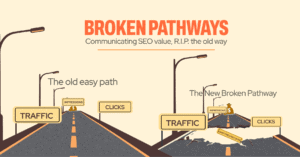
For years, the value story was simple enough to explain. Better rankings brought more traffic, clicks, conversions, and hopefully revenue.
Now, people can discover and evaluate brands without clicking, while organic traffic keeps falling.
If your reporting still starts and ends with rankings and sessions, you’re leaving decision-makers to connect the dots themselves.
This article breaks down FREDA, a five-part framework for turning SEO performance into a business case people can understand and act on.
SEO metrics need business context
Rankings, traffic, and clicks still matter, but they rarely answer the question your client or leadership team cares about most.
What did this do for the business?
A 20% increase in visibility sounds good, but it becomes more useful when you can show that it supports a priority product, reduces reliance on paid search, protects revenue, or creates an opportunity the business can act on.
Across 24 contract renewals observed over 12 months, five communication behaviours kept showing up in the successful conversations. Nineteen contracts were renewed, retaining roughly $450,000 in value.
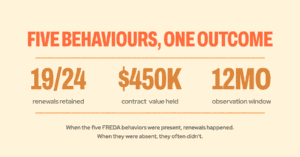
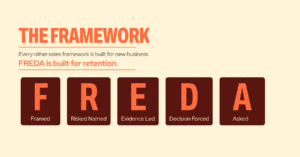
Those behaviours make up the FREDA framework — Frame, Relate, Excite, Demonstrate, and Ask.
Frame the conversation around the business problem
Start with the situation your stakeholder is dealing with, then explain what the SEO data means within that context.
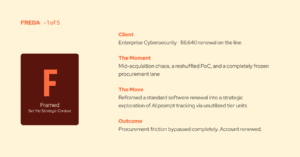
A cybersecurity company going through an acquisition had frozen procurement and was using only part of its keyword-tracking capacity. On paper, that looked like wasted spend.
But the unused capacity could also support new work around AI visibility, query fan-out, and long-tail tracking without increasing the contract.
The value changed once the business context changed.
So before presenting rankings, traffic, or visibility, ask what is happening in the business and how your work helps with it. That gives the numbers a reason to matter.
Relate the work to what your stakeholder needs
Once the context is clear, look at the person carrying the pressure.
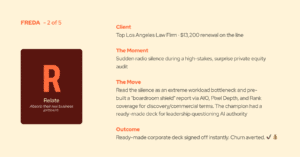
A law firm preparing for a private equity audit needed to understand its AI visibility, but the bigger issue was making that information useful for the audit itself.
So the value was not another dashboard. It was giving the team the reporting and context they needed to answer tougher questions internally.
That is the shift to make in your own reporting.
Think about what your stakeholder needs to explain, defend, or decide after your meeting, then shape your SEO story around that.
Excite them about what becomes possible
Once your stakeholder understands the problem and how it affects them, give them a reason to invest in the next step.
This means showing what the work could unlock.
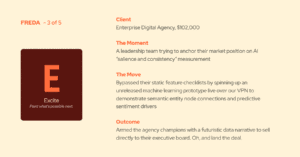
For one enterprise agency, the missing piece was a feature they needed for better AI measurement. The feature did not exist yet, but showing what it could enable gave the team a clearer reason to keep investing.
The same applies to SEO.
If stronger reporting could help leadership see AI visibility more clearly, or a new workflow could uncover opportunities the team currently misses, show that future state.
Keep it grounded in a problem they already care about. The goal is to make the upside clear enough that moving forward feels worthwhile.
Demonstrate the value with something tangible
A promising idea is easier to support when people can see how it could work.
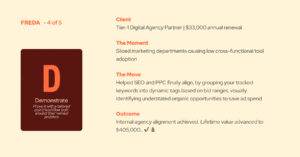
One way to do this is by connecting SEO data to another part of the business. For example, combining SEO and PPC keyword data can reveal where stronger organic visibility could reduce paid spend.
Now the conversation has moved beyond rankings.
You can point to a specific opportunity, show what it could save or improve, and give your stakeholder something concrete to evaluate.
A small test, report, or workflow can be enough to make the wider opportunity easier to believe.
Ask for the decision you need
Even a strong case can stall if nobody knows what should happen next.
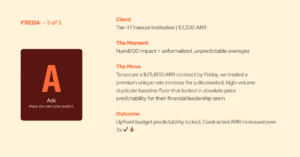
If a client is unhappy with unpredictable overage costs, for example, the next step could be a new pricing structure that gives them more predictability while still protecting the value of the contract.
The same principle applies to SEO.
If you need more budget, ask for it. If you need access to another team, ask for it. If renewal is approaching, bring it into the conversation.
Once the value is clear, make the next decision clear too.
Make SEO easier to understand and easier to fund
FREDA works because it turns SEO reporting into a decision-making tool.
You frame the business problem, connect the work to what your stakeholder needs, show what could improve, prove that the opportunity is within reach, and make the next step clear.
This matters more as AI search makes attribution harder and familiar metrics less complete.
Your stakeholders may not understand every new visibility metric, but they still understand revenue, cost, risk, and growth.
Translate your SEO work into those terms, and it becomes much easier to defend the investment behind it.