This blog post is a repurposed Sip & Search session sponsored by Profound.
Your content can cover a topic well and still not be visible in AI search for that topic.
When a user asks one question, AI may search for several related things before it answers.
In his Sip & Search session, John Iwuozor breaks down how this works and how to use it to improve your chances of showing up.
But first, we need to understand what query fan-out really is.
What is query fan-out?
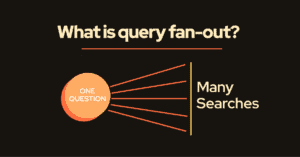
When you ask an AI system a complex question, it may need more information than your prompt provides.
So it breaks your question into several related searches and uses the results to build a more complete answer.
Say you search for “best CRM for a small sales team.” The system could fan that prompt out into searches around:
- CRM options for small teams
- Pricing
- Free plans
- Key features
- Ease of use
- Comparisons between specific products

Your original prompt stays at the centre, while the AI explores several angles around it before deciding what information to include in its response.
This changes what visibility looks like. Your page can become useful to the AI through one of those supporting searches, even when it does not match the user’s original wording word-for-word.
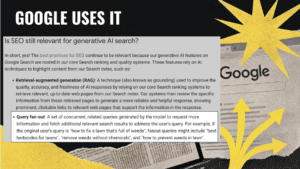
And Google is using this approach too, with its AI search systems generating multiple related queries to gather the information needed to respond.
So how do you turn query fan-out into a strategy for improving AI visibility?
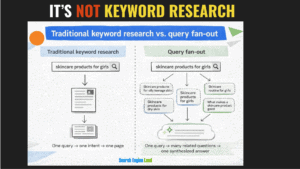
1. Stop treating query fan-out like keyword research
Traditional keyword research often gives you a cleaner path. One query, intent, and page.
Query fan-out is less predictable.
The same prompt can produce different sub-queries depending on the wording, platform, user’s context, and conversation leading up to it. A study found that only 27% of fan-out queries stayed consistent across repeated tests.
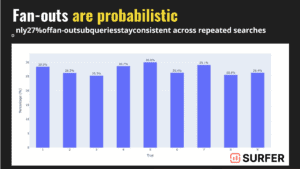
This means you should avoid treating fan-out queries like a fixed keyword list.
A better approach is to look for the patterns underneath them.
Some fan-outs compare products. Others look for reviews, pricing, alternatives, up-to-date information, or use-case-specific details.
Your job is to understand those recurring needs and build content that covers them well.
2. Pay attention to the patterns behind fan-out queries
You do not need to predict every sub-query an AI system might generate. What matters more is spotting the patterns that keep showing up.
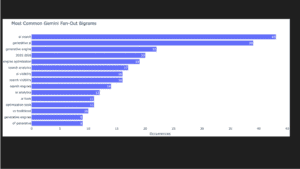
Across John’s research, fan-outs often included:
- Reformulations of the original prompt
- Comparisons between products or options
- Evaluation terms such as “best,” “top,” and “alternatives”
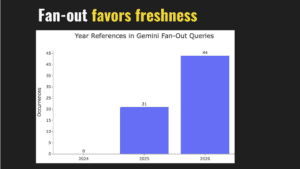
- Freshness modifiers such as 2025 or 2026
- Reviews, pricing, and commercial details
- Queries shaped by the user’s specific situation
He also found that not every prompt triggered fan-out. Stable questions could often be answered directly, while queries that depended on current information were more likely to generate additional searches.
These patterns give you clues about the information an AI system may need before it can confidently recommend a product, service, or brand.
3. Start with the prompts closest to revenue
Do not start by mapping every question your audience could ask.
Start with the prompts most likely to influence a buying decision.
For example:
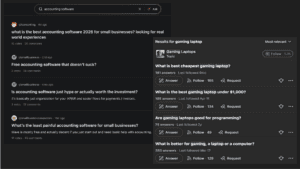
- What is the best accounting software for a small business?
- Which CRM is best for a five-person sales team?
- What are the best alternatives to [competitor]?
- Which content optimization tool is best for a startup?
These are your money prompts.
You can find them in places where people already ask for recommendations, including Reddit, Quora, customer conversations, sales calls, and your own search data.
Once you have a shortlist, you can start exploring the fan-outs behind them.
4. Simulate the fan-outs behind those prompts
Once you have your money prompts, use fan-out tools to see the kinds of related searches an AI system could generate around them.
Some of the best tools include Qforia, Google Query Fanout Extractor, and QueryFan. They will not give you a perfect record of every hidden search, but they can help you spot useful patterns.
Then classify the sub-queries you find by three things:
- Type such as comparison, reformulation, personalization, entity expansion, or related question
- Intent based on what the user is trying to learn or decide
- Format such as a comparison table, shortlist, definition, pricing breakdown, review, or step-by-step guide
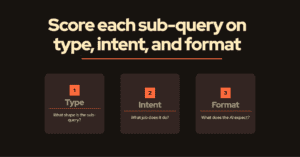
This is more useful than a spreadsheet full of query variations. You start to see what information AI systems may need around the topic and how that information should be presented.
5. Find the themes that keep appearing
When you start collecting fan-out queries, the list can get long very quickly.
Do not create a separate page for every variation because fan-outs change across users, platforms, and prompts, so chasing them one by one will waste time.
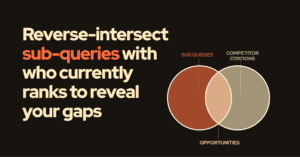
Instead, group the queries into broader themes.
For a CRM topic, the themes might include pricing, integrations, team size, ease of use, alternatives, implementation, and reviews.
Then compare the themes with the sources AI systems already cite. If competitors consistently appear around a topic you barely cover, that gives you a useful content gap to investigate.
The goal is to understand which parts of the topic keep influencing the final answer, then strengthen your coverage around them.
6. Build for semantic completeness
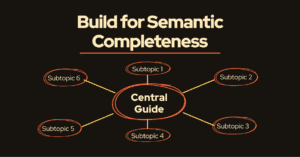
Once you know the recurring themes, build content around the full topic rather than isolated query variations.
If you are covering CRM software, you could answer questions around pricing, team size, integrations, ease of use, setup, alternatives, strengths, and limitations.
The aim is to give AI systems enough context to understand the topic and your place within it.
This is where strong SEO fundamentals still help. Clear structure, useful internal links, relevant entities, and complete topical coverage make it easier for your content to support several related fan-out queries at once.
7. Make important information easy to extract
Strong topical coverage helps, but your key information still needs to be easy to find.
Front-load the answer by putting the most useful facts near the top of the page instead of burying them after a long introduction.
Then make the rest of the content easy to scan and understand. Some things to note:
- Use clear headings
- Name products, brands, and entities directly
- Add original data and first-hand testing where possible
- Include pricing, reviews, comparisons, and alternatives when they matter
- Keep time-sensitive information fresh
- Use dates or year modifiers where freshness affects the answer
You can also use a BLUF approach, where you give the most important information first and add supporting detail afterwards.
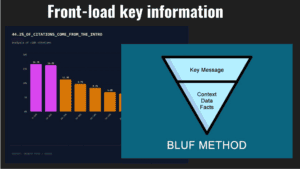
This makes it easier for AI systems to extract useful information from your page and use it across related fan-out searches.

8. Track your money prompts across AI platforms
Once you have optimized around the themes that matter, track the prompts closest to revenue across the AI platforms your audience uses.
Check:
- Whether your brand appears
- Whether your pages are cited
- Which competitors show up
- Which sources influence the answer
- How those results change over time
Do this separately for each platform because query fan-out does not behave the same way everywhere. ChatGPT, Gemini, Perplexity, and other systems can interpret and expand the same prompt differently.
You also do not need to track every possible fan-out query.
Focus on your money prompts and monitor whether your visibility improves around the commercial topics that matter to your business.

Use query fan-out to strengthen the whole topic
Query fan-out gives you a useful way to understand what an AI system may need before it can produce a confident answer.
You may not be able to predict every hidden search, but you do not need to.
Just start with your money prompts, study the fan-outs around them, group recurring queries into themes, and strengthen the gaps that matter most.
Then make the information easy to extract and track whether your visibility improves across the AI platforms your audience uses.
The better your coverage around the full topic, the more opportunities you create to become part of the final answer.
Watch John Iwuozor’s full Sip & Search session for the complete presentation.