This blog post is a repurposed Sip & Search session sponsored by Profound.
Getting cited by AI can be a blessing and a curse.
That’s mostly because your brand can show up in AI search misrepresented, diluted by competitors, and associated with outdated or incorrect perceptions.
Nick Lafferty calls this the Parrot Problem.
In his Sip & Search session, Nick breaks down why this happens and what marketers can do to influence the accuracy and sentiment of what LLMs say about their brands.

What is the Parrot Problem?
Someone asks ChatGPT about the Nike Alphafly 3.
It answers the question, then goes further by suggesting alternatives from Adidas and Saucony.

Southwest had a similar problem. After changing its open-seating policy, ChatGPT still repeated outdated information about unassigned seating in a group-travel recommendation.

In both cases, the brands showed up, but not in the best way, and this happens often.
Profound analyzed 50,000 responses across seven industries and found that around 47% of the content was unsolicited. This included:
- Comparisons
- Rankings
- Recommendations
- Fee caveats
- Follow-up advice

LLMs tend to keep talking, which gives them more room to introduce competitors, repeat outdated information, or shape how people see your brand.
So how do you influence how LLMs present your brand in AI Search? There are 3 ways you can do that.
1. Audit accuracy and sentiment
Start by actually asking the models the same set of questions your customers would ask and logging the outputs side by side.
For example: “What is Linear used for?”, “Who is it for?”, “What are the limitations?”, “What are alternatives?”
In Nick’s examples, the gaps show up clearly. Linear was repeatedly framed as engineering-only software, even though that is not true.
In another case, Profound found that 11.2% of tracked claims were factually incorrect, which became visible only when outputs were systematically compared against source-of-truth product information.

Use your own product pages, pricing pages, docs, and FAQs as the “ground truth,” then score the model outputs against them: what is correct, what is missing, and what is wrong.
Then go one level deeper than accuracy: look at patterned sentiment. Are you consistently being positioned as “expensive,” “enterprise-only,” “hard to use,” or “missing X feature”? Treat those as signals, not opinions.
Finally, trace where that language is likely coming from. In practice, this usually maps back to a small set of sources: outdated review pages, comparison blogs, Reddit threads, G2/Capterra listings, or old positioning copy that still ranks.
The goal is not just to “check accuracy,” but to produce a concrete list of:
- incorrect claims to fix or counter
- recurring narratives to address
- specific external pages shaping those narratives
This becomes your working backlog for influence.
2. Give LLMs better material to work with
Once you know what needs correcting, you have to actively replace weak information with stronger sources that LLMs are more likely to cite.
Right now, most brands rely on the same kind of content AI systems already see everywhere else, like blog posts, feature pages, and marketing copy. The problem is that LLMs don’t treat those as authoritative because it’s easy to find and easy to replicate.
Instead, you need to give them inputs they can’t easily reconstruct from the open web.
An LLM can summarize thousands of running-shoe reviews. It cannot wear the shoe for 300km, measure midsole compression over time, compare weight changes across sizes, or document how performance degrades after repeated use.

This is your advantage.
So the goal is to create content based on direct evidence. For example:
- Physically test products and publish the results (benchmarks, teardown-style analysis, comparisons)
- Publish proprietary data (usage stats, performance metrics, customer behavior insights)
- Run controlled experiments (A/B tests, pricing tests, feature adoption tests)
- Document real customer research (interviews, surveys, support patterns)
- Produce expert interpretation of raw data, not just summaries of existing opinions
Nick calls this non-commodity content because it isn’t interchangeable with what already exists online.
The more your content is rooted in firsthand measurement, observation, or unique data, the harder it is for AI systems to ignore or replace it with generic summaries.
Keep important content fresh
Original information helps, but it also needs to stay current.
Profound found that 50% of top-cited content is less than 13 weeks old.

In practice, this means you need a clear update loop for high-impact pages:
- Pricing pages → update immediately when anything changes (even small plan or packaging shifts)
- Product feature pages → refresh whenever a release ships, not in quarterly batches
- Comparison pages → revisit whenever competitors change pricing, positioning, or features
- Research/thought leadership → add new data points or findings regularly, not just rewrite intros
The key point Nick makes is that “freshness” is structural, as LLMs are effectively learning from what looks actively maintained.
Updating should therefore mean upgrading the underlying truth, not just changing wording to signal activity.
If your product has changed, your highest-visibility pages need to change with it, otherwise AI systems will continue to cite an outdated version of your reality.
Be specific about what makes your product different
Fresh information is more useful when it gives LLMs something concrete to work with.
Claims like “enterprise-grade” or “best-in-class” do not say much on their own. But a figure such as “99.99% uptime” gives the model a fact it can understand, compare, and repeat.
The same applies to pricing, response times, integrations, product performance, and other details customers may care about.
Replace vague positioning with clear evidence wherever you can.
It gives LLMs better information to describe your brand with and reduces the chances of them filling in the gaps themselves.

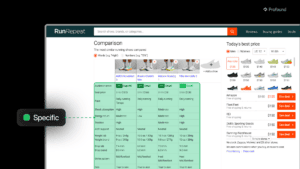
3. Become the RunRepeat of your industry
Profound’s running-shoe data showed RunRepeat with a 7.1% citation share, compared with 2.4% for Nike.com.

That is a huge gap for a specialist publisher competing with one of the biggest sports brands in the world.
RunRepeat earns this visibility by creating information others cannot easily replicate.
The team buys running shoes, weighs them, cuts them open, tests them, and compares the results with manufacturer claims. They also show when reviews were updated and which products they plan to test next.
So when LLMs need detailed information about running shoes, RunRepeat gives them plenty to work with.
Think about what the RunRepeat equivalent looks like in your industry.
What can you test, measure, compare, or experience firsthand that would give people and LLMs a reason to reference you?


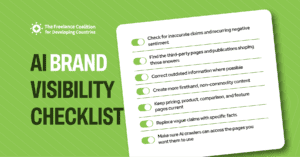
A practical checklist for improving how your brand appears in AI search
You do not need to overhaul everything at once.
Start with the parts of your brand that AI systems are already using to form an opinion.
- Check for inaccurate claims and recurring negative sentiment
- Find the third-party pages and publications shaping those answers
- Correct outdated information where possible
- Create more firsthand, non-commodity content
- Keep pricing, product, comparison, and feature pages current
- Replace vague claims with specific facts
- Make sure AI crawlers can access the pages you want them to use
The last check is easy to overlook. Even Profound discovered that its own pricing page was inaccessible to AI crawlers. If the same thing happens on your site, LLMs may rely on weaker or outdated sources instead.
AI search is creating a new kind of marketer
As AI search becomes part of everyday marketing, the work is expanding beyond content and reporting.
You may need to build systems that track sentiment, flag inaccurate claims, monitor citations, or identify pages that need updating.
Nick calls this role the marketing engineer.
But title matters less than the skill set. You need to understand the problem, build a useful workflow around it, and know how to improve that workflow when it breaks.
For marketers working in AI search, this ability will become increasingly valuable.
Visibility only helps when the narrative works in your favour
Showing up in AI search is useful, but a mention alone doesn’t tell you whether the answer is helping your brand.
You also need to know what LLMs are saying, where that information comes from, and whether the sources shaping the response are accurate and current.
Then give AI systems better material to work with through firsthand content, specific claims, fresh information, and pages they can access easily.
The more useful information you put into the ecosystem, the better your chances of influencing how your brand is represented.
Watch Nick Lafferty’s full Sip & Search session for the complete talk and examples.